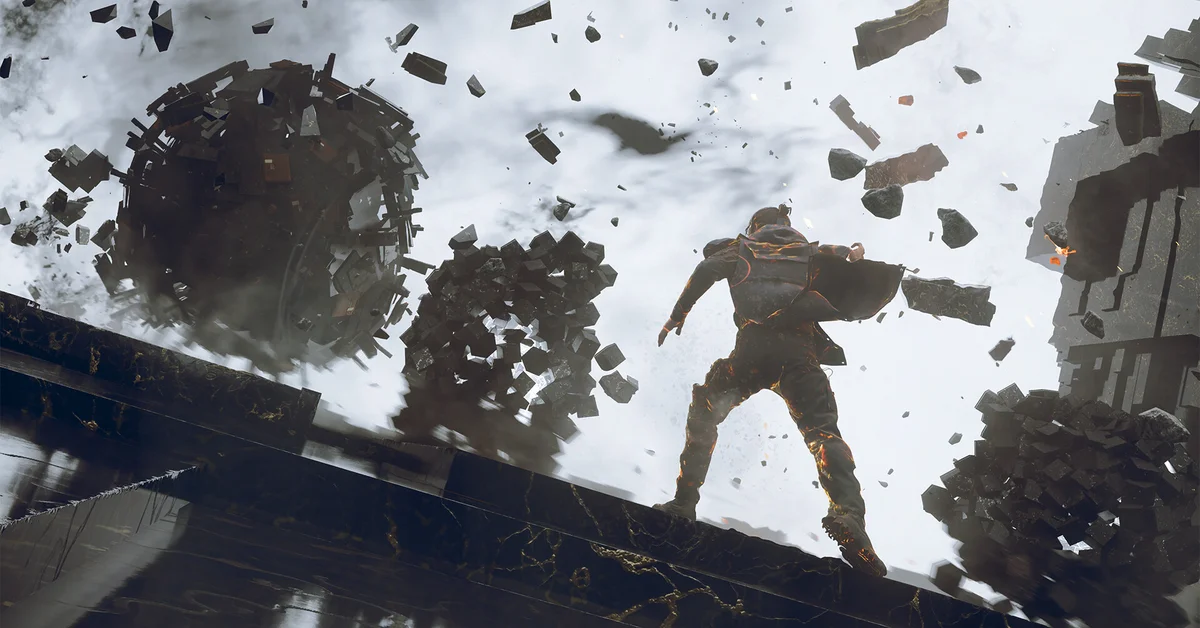
Control Resonant asks for a GTX 1070 or RX 5600 XT minimum, an RTX 3060 Ti or RX 6700 XT recommended, 16 GB of RAM at every tier, and 120 GB of SSD space. The detail worth catching before you buy: almost every published tier above minimum assumes you are using upscaling.
The Steam Store Tiers
Minimum: Intel i5-8500 or Ryzen 5 3500, 16 GB RAM, GTX 1070 / RX 5600 XT / Arc A580, 120 GB SSD.
Recommended: Intel i7-10700 or Ryzen 7 3700X, 16 GB RAM, RTX 3060 Ti / RX 6700 XT / Arc B580, 120 GB SSD.
Windows 10 or 11, 64-bit, throughout.
The Full Published Table
Remedy published an expanded sheet that is more useful than the store listing, because it tells you what each tier actually targets:
| Tier | Target | Settings |
|---|---|---|
| Minimum | 1080p / 30 | Low, FSR Quality upscaling, no ray tracing |
| Recommended | 1440p / 60 | Medium, DLSS or FSR Balanced |
| High rasterized | 4K / 60 | High, RTX 3080 or RX 6800 XT, DLSS or FSR Performance |
| RT minimum | – | i7-8700K or Ryzen 5 3600X, RTX 2060 Super / RX 6600 / Arc A580 |
| RT recommended | 1440p / 60 | Medium RT, RTX 4070 Ti or RX 9070, 10 GB VRAM, DLSS or FSR Balanced |
| Path tracing | 4K / 60 | RTX 5080 with DLSS Performance |
Note that the minimum tier already assumes FSR Quality. Upscaling is not the optimisation of last resort here, it is the baseline assumption.
Upscaler Support, and One Gap
Resonant supports DLSS 4.5 and FSR 4, plus ray tracing and path tracing, built on Remedy’s Northlight engine with RTX Mega Geometry.
Intel XeSS is not supported. That creates an odd situation worth flagging: Intel Arc GPUs appear in both the minimum and RT-minimum specs, yet Arc owners have no access to Intel’s own upscaler and will be running FSR instead.
What Benchmarks Show
Independent testing found the game is GPU-bound even at 1080p without ray tracing, so a modern CPU is unlikely to be your bottleneck. Most current GPUs clear 60 FPS at 1080p on Ultra.
Only an RTX 5090 holds native 4K Ultra without upscaling.
Path tracing roughly halves performance. An RTX 5080 reportedly drops to around 20 to 22 FPS at native 4K, recovering to roughly 52 to 57 FPS with DLSS 4.5 Performance. Multi-frame generation is described as clean with minimal artifacting during camera movement.
One known blemish in the same testing: character model fidelity lags behind the environments.
Practical Advice
Turn path tracing off unless you own a 5080 or better and are comfortable running DLSS Performance. Ray tracing at Medium on a 4070 Ti class card is the sensible middle. Treat the 120 GB SSD requirement as firm rather than aspirational, since scraped install sizes for the console versions run around 86 to 106 GB and the store lists 120.
If performance is still not where you want it, our Assist Mode guide covers the game-speed and combat sliders, which can compensate for a lower frame rate in a way settings alone cannot.
Frequently Asked Questions
What GPU do I need for Control Resonant?
A GTX 1070 or RX 5600 XT minimum, with an RTX 3060 Ti or RX 6700 XT recommended for 1440p 60 with upscaling.
Does it support XeSS?
No. DLSS 4.5 and FSR 4 are supported, but Intel XeSS is not, despite Arc GPUs appearing in the specs.
How much storage does it need?
120 GB on an SSD, per the Steam listing.
Is path tracing worth it?
Only on high-end hardware. It roughly halves performance, and 4K 60 with path tracing is specified for an RTX 5080 using DLSS Performance.