
The best book about the video game industry is Blood, Sweat, and Pixels, Jason Schreier’s inside look at how some of the biggest games of the 2010s got made, followed by Masters of Doom and Console Wars. The rest of the list covers the business from every side: the rise and fall of Blizzard, the studios that closed after shipping their biggest games, the full history of the console makers, how Nintendo conquered the game business, a co-founder’s own account of building Doom, the fight over who owned Tetris, and the thinking of the man who ran Nintendo through the DS and Wii years.
We ranked them on standing, on how well each one reads today, and on how much of it is about the industry itself: studios, publishers, platform makers and the people who work inside them. Every book here is on sale new today, in print, as an ebook or as an audiobook, according to its publisher. For culture, criticism and novels, see our list of the best books about video games; for learning to make games yourself, see our best game design books.

10. Ask Iwata
Author: Satoru Iwata, edited by Hobonichi (VIZ Media, 2021). Best for: readers who want to know how a Nintendo president thought about leadership, teams and making games.
Ask Iwata is the only book on this list told in the voice of someone who ran a platform maker. Satoru Iwata was a programmer before he became Nintendo’s global president and CEO, and he led the company through the Nintendo DS and the Wii (our picks for the best DS games and best Wii games show what that era produced). This slim 176-page collection, drawn from the Iwata Asks interviews with the people behind Nintendo’s games and hardware, covers practical lessons such as finding bottlenecks, how success breeds resistance to change and why programmers should never say no, and it includes conversations with Shigeru Miyamoto and EarthBound creator Shigesato Itoi. VIZ Media calls it a USA Today bestseller. It ranks tenth only because it is a short book of ideas rather than a full account of the business.

9. The Tetris Effect
Author: Dan Ackerman (PublicAffairs, 2016). Best for: readers who want a fast business thriller about rights, licensing and one game that everybody played.
The Tetris Effect: The Game That Hypnotized the World is about a single game, but most of it is a business story. Dan Ackerman starts with Alexey Pajitnov, the Soviet programmer who built Tetris on old, unreliable computers, then follows what happened once the game slipped through the Iron Curtain: British, American and Japanese businessmen sent their fixers around the globe to close backroom deals for the rights, while ELORG, a secretive Soviet organization, chased the game’s growing profits. No other book here shows as clearly that the industry runs on contracts and licensing as much as on code.

8. Doom Guy
Author: John Romero (Abrams Press, 2023; paperback 2024). Best for: readers who want the early PC game business from a founder who helped build it.
Doom Guy: Life in First Person is the founder’s side of a story this list tells twice. Masters of Doom is a reporter’s account; here John Romero, co-founder of id Software and co-creator of Wolfenstein 3-D, Doom and Quake, tells it himself, beginning with his days as a self-taught teenager submitting Apple II game code to computer magazines. What makes it an industry book is how much of it is about partnerships and the business around the games: Romero walks through the creative and business relationships that shaped his career, at their best and their worst, and draws hard-earned lessons about design, code and the industry he helped define. Abrams quotes Forbes calling it the best nonfiction gaming book of all time. It ranks just below Game Over because a memoir sees the industry from one desk, while Sheff takes in a whole company.

7. Game Over
Author: David Sheff (Random House, 1993; sold new today as a Vintage ebook). Best for: readers who want the classic account of how Nintendo took over the American game business.
Game Over: How Nintendo Conquered the World is the oldest book on this list and still the standard account of Nintendo’s first run at the top. David Sheff tells the company’s rise as a tale of innovation and cutthroat tactics, built on interviews with Nintendo executives in Japan, Europe and the United States, and it doubles as a case study in management and corporate culture. It also has chapters on Alexey Pajitnov and Tetris, which make it a natural companion to The Tetris Effect. The catch is its age: it came out in 1993, so the story stops there, and today it is sold new only as an ebook.

6. The Ultimate History of Video Games
Author: Steven L. Kent (Crown, 2001; Volume 2, 2021). Best for: readers who want the whole history of the business, from the arcades to the PlayStation 2 era, in two volumes.
Steven L. Kent’s two volumes are the closest thing the industry has to a reference history. Volume 1, From Pong to Pokemon and Beyond, covers the arcade craze of Space Invaders and Pac-Man, the misstep that helped topple Atari, the game that saved Nintendo from bankruptcy and the rise, fall and rebirth of Sega, drawn from Kent’s interviews with hundreds of people who built the business. Volume 2, Nintendo, Sony, Microsoft, and the Billion-Dollar Battle to Shape Modern Gaming, picks up as the PlayStation 2, GameCube and Dreamcast made very different bets on what players wanted, follows Microsoft’s entry into consoles, and digs into the origins of series such as Grand Theft Auto, Halo and Call of Duty. Between them they run to more than 1,200 pages, so this is the history to keep on the shelf rather than the one to start with.

5. Press Reset
Author: Jason Schreier (Grand Central Publishing, 2021). Best for: readers who want to understand layoffs, studio closures and why game jobs are so unstable.
Press Reset: Ruin and Recovery in the Video Game Industry is the book on this list most squarely about work. Jason Schreier, who covers the industry for Bloomberg News, follows the people behind games such as BioShock Infinite, Epic Mickey and Dead Space through the shutdowns of the studios that made them, then asks what came next: who recovered, who moved on and who left games for good. Along the way come hostile takeovers, abusive bosses, bounced checks and the time former Boston Red Sox pitcher Curt Schilling set out to build a studio that would take on World of Warcraft. Its publisher calls it an instant New York Times bestseller, and its central question, why it is so hard to make a stable living in such a successful industry, is still the right one to ask.

4. Play Nice
Author: Jason Schreier (Grand Central Publishing, 2024). Best for: readers who want one company’s whole story, from student startup to life inside a corporate parent.
Play Nice: The Rise, Fall, and Future of Blizzard Entertainment follows one studio across 33 years, which makes it the best single portrait here of how a game company changes as it grows. Schreier traces Blizzard from two UCLA students who wanted to make the games they wanted to play, through Diablo and World of Warcraft, to the cancelled project in 2013 that gave Activision CEO Bobby Kotick the opening to rein in Blizzard’s independence, and on through glitchy products, PR disasters, mass layoffs and a staggering lawsuit. It is built on firsthand interviews with more than 300 current and former employees, and Hachette lists it as a New York Times bestseller and an NPR best book of 2024. Where Press Reset is about what the business does to the people in it, Play Nice shows the same pressures reshaping one beloved company from the inside.

3. Console Wars
Author: Blake J. Harris (Dey Street Books, 2014). Best for: readers who want the business side of the 16-bit war between Sega and Nintendo.
Console Wars: Sega, Nintendo, and the Battle That Defined a Generation is the best book about competition in this industry. In 1990 Nintendo had a near monopoly, and Blake J. Harris follows how Tom Kalinske, a newcomer who knew nothing about video games, turned Sega from a faltering arcade company into a real rival, in a fight waged from living rooms and schoolyards to boardrooms and Congress, with Sonic against Mario at the center of it. It is built on more than 200 interviews with former Sega and Nintendo employees, and HarperCollins, which pitches it as a business thriller, notes that NPR, Slate and Publishers Weekly each named it a best book of the year. For the games at the heart of it, see our Sonic hub and our best SNES games.
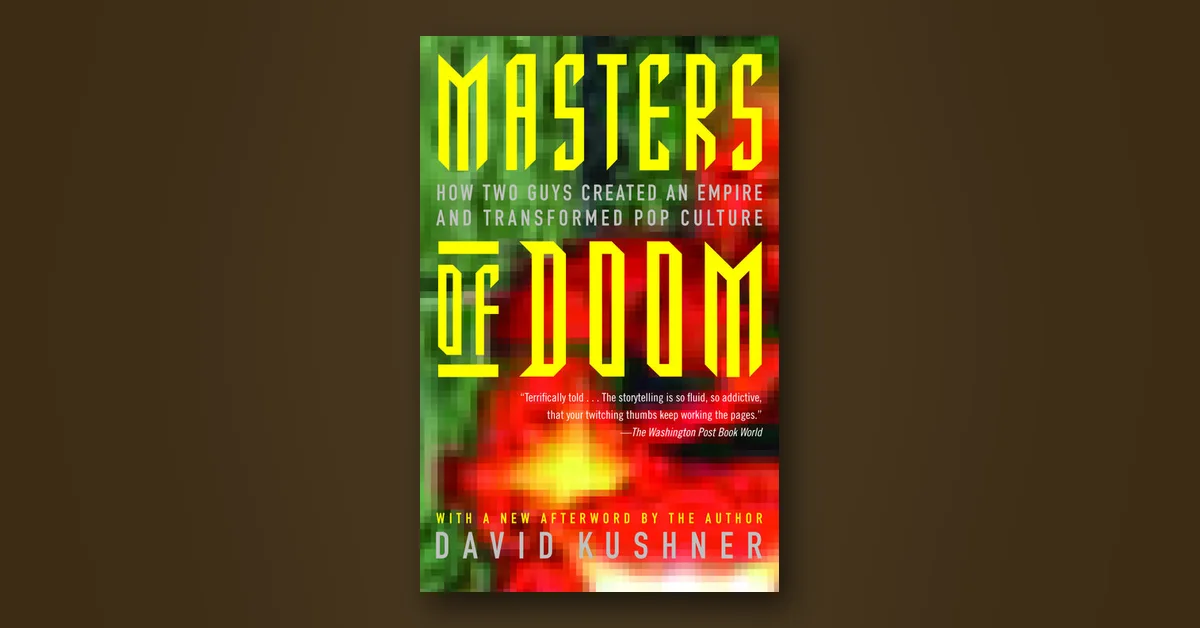
2. Masters of Doom
Author: David Kushner (Random House, 2003). Best for: readers who want the founding story of a game studio, from two young outsiders to a company that changed the business.
Masters of Doom: How Two Guys Created an Empire and Transformed Pop Culture is the best book about starting a game company. David Kushner follows John Carmack and John Romero as they escape troubled childhoods, build id Software as two rebellious entrepreneurs and turn Doom and Quake into some of the most successful franchises of their era, before those same games drive them apart. As an industry book, it is a study of founders: how a tiny company grows rich and famous, how a partnership strains under success, and how a studio ends up at the center of a national controversy over violent games. Random House presented it as the first book to chronicle the industry’s greatest story, and more than two decades later it is still the one we would hand to anyone thinking of starting a studio. It also appears on our list of the best books about video games, for its place in gaming culture.
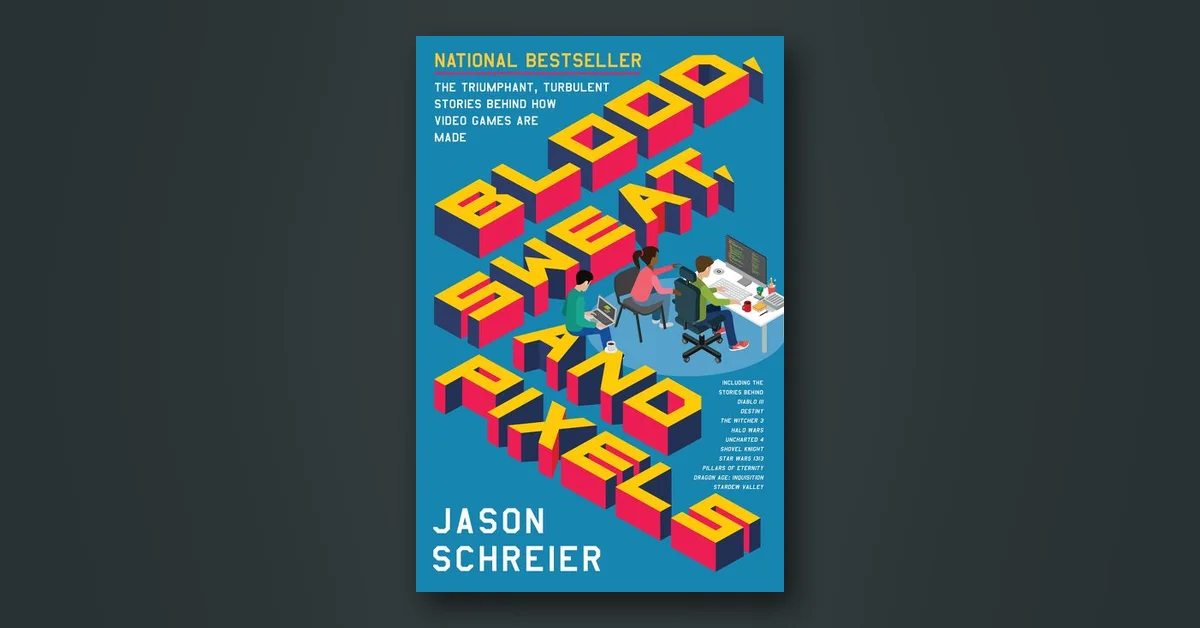
1. Blood, Sweat, and Pixels
Author: Jason Schreier (Harper Paperbacks, 2017). Best for: anyone who wants to know how games really get made, and why finishing one is so hard.
Blood, Sweat, and Pixels: The Triumphant, Turbulent Stories Behind How Video Games Are Made is the best book about the video game industry because it shows the work itself, one game at a time, at every size of studio. Schreier goes inside Naughty Dog as it reboots Uncharted 4, BioWare as it fights an impossible schedule and one technical nightmare after another on Dragon Age: Inquisition, and Bungie as it spins out from Microsoft to build Destiny. He follows Eric Barone’s five years of making Stardew Valley alone, Obsidian Entertainment saved from the brink of collapse by the Kickstarter for Pillars of Eternity, and the work that went on long after release day for Diablo III and The Witcher 3.
What makes it the right first book is how much of the industry fits into one readable volume. Big studios under pressure, a solo developer, crowdfunding, corporate interference, crunch and burnout all turn up, and none of it needs any background in how games are made. HarperCollins calls it a national bestseller, and it is the place to start with Schreier, whose Press Reset and Play Nice sit further down this list. If its BioWare chapter leaves you curious about the studio, our BioWare games in order covers everything it has made.
Where to Start
If you only want one book about how the business works, start with Blood, Sweat, and Pixels. For the history, read The Ultimate History of Video Games in order, then Console Wars for the Sega and Nintendo years in close-up. For Nintendo, read Game Over for its rise through the early 1990s and Ask Iwata for how the company was run from the top. For id Software, read Masters of Doom first and then Doom Guy, John Romero’s own account. For the people who work in games today, read Press Reset and then Play Nice.
How We Chose
We weighed each book’s standing (the bestseller lists and best-of-the-year picks its publisher cites, and how widely it is recommended to people learning how the industry works), how well it reads today, and how much of it is about the business rather than about playing games. Every pick had to be on sale new as a print book, ebook or audiobook on its publisher’s own page. We left out design textbooks, which have their own list, and books about the experience of playing and loving games, which belong on our list of the best books about video games. Nintendo and id Software each get two books because each pair covers a different angle: Game Over tells Nintendo’s cutthroat 1980s rise and Ask Iwata gives the view from the president’s office, while Masters of Doom is the reporter’s account of id Software and Doom Guy is a co-founder’s own. Keza MacDonald’s Super Nintendo, the newest full history of the company, sits on our list of the best books about video games instead.
Frequently Asked Questions
What is the best book about the video game industry? Blood, Sweat, and Pixels by Jason Schreier. It follows well-known games from big studios and a solo developer through development and needs no background to follow. Masters of Doom and Console Wars are the next best.
What are the best books about video game history? The Ultimate History of Video Games by Steven L. Kent, in two volumes, is the most complete history of the business. Console Wars covers the Sega and Nintendo years in more depth, and Game Over tells the story of Nintendo’s rise.
What are the best books about video game development? Blood, Sweat, and Pixels is the best look at how games actually get made, followed by Masters of Doom and Press Reset. For books that teach you to design games yourself, see our list of the best game design books.
What is the best video game book of all time? For the industry, Blood, Sweat, and Pixels, with Masters of Doom close behind. Masters of Doom is also on our list of the best books about video games, which covers culture, criticism and novels.
Which Jason Schreier book should I read first? Blood, Sweat, and Pixels, then Press Reset and Play Nice. Each one stands alone, but together they move from how games get made, to what happens when studios close, to the full history of one company.
Is Console Wars a true story? Yes. Blake J. Harris built it on more than 200 interviews with former Sega and Nintendo employees, and it follows real executives such as Tom Kalinske, who led Sega’s fight against Nintendo.
Are there good books about Nintendo’s history? Yes. Game Over by David Sheff covers Nintendo’s rise through the early 1990s, and Ask Iwata collects the thinking of Satoru Iwata, who led Nintendo as president. For the newest full history, Super Nintendo by Keza MacDonald, on our list of the best books about video games, brings the story up to the Switch.