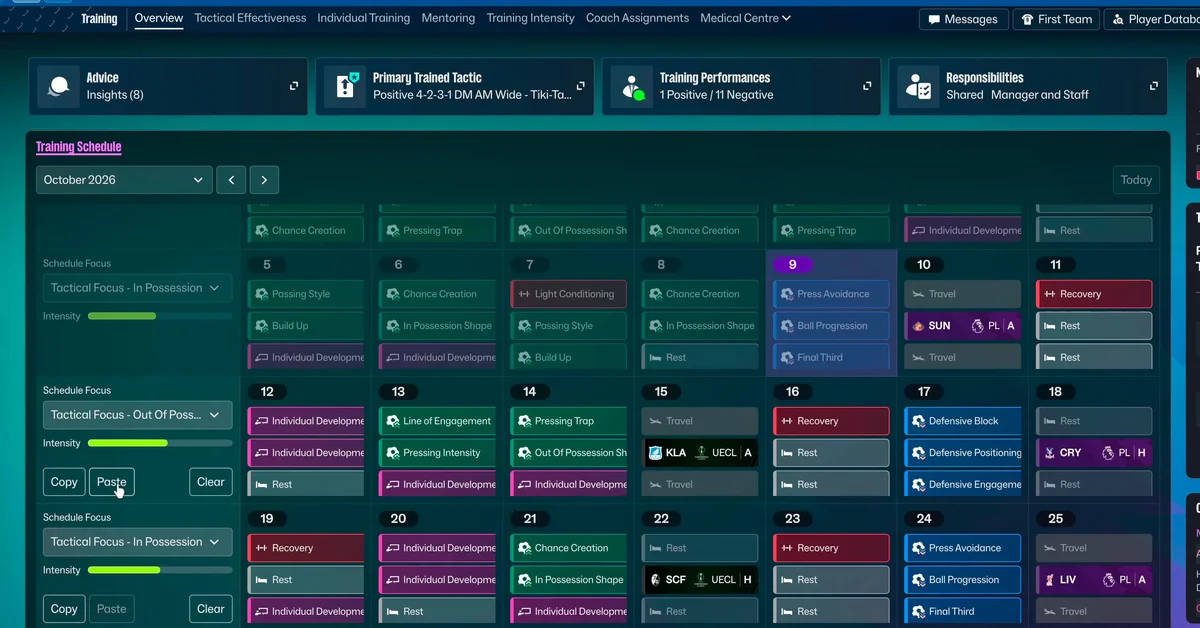
The best Football Manager 27 training schedule is built around your next match: Recovery and Rest the day after a game, team sessions that match your tactic in midweek, and three opponent-focused sessions the day before kick-off. Sports Interactive’s own example schedule is built the same way, and it fits how Football Manager 27 rebuilt Training around “preparation for the next match and opposition.”
Below we explain how FM27 training works now, then give the weekly schedules we would run for a one-match week, a two-match week, pre-season and an international break, plus how to handle intensity and individual training. The systems come from SI’s deep dives and its screenshots of a pre-release build; the schedules themselves are our recommendations built on those rules.
How Training Works in FM27
SI’s Training and Tactical Effectiveness deep dive lays out the biggest change: “The previous Units system, primarily centred around developing player attributes, has been replaced with options and setups that focus on the goal of executing a tactical plan in the next match.” Your senior squad is now “more attuned with match preparation, focusing more on team cohesion and tactical understanding.”
Here is how the screen fits together, from SI’s feature and its screenshots:
- Training has its own tab on the main navigation bar, with sub-tabs for Overview, Tactical Effectiveness, Individual Training, Mentoring, Training Intensity, Coach Assignments and the Medical Centre.
- Each week has a Schedule Focus. The options shown are Tactical Focus: In Possession, Tactical Focus: Out Of Possession and Tactical Focus: Balanced, and each week has its own Intensity slider.
- Each day has three session slots, and a week can be copied, pasted and cleared. SI confirms that copying and pasting training plans “is once again available.”
- Load is visible ahead of time. SI says the screen shows “more visual indicators on the physical load that your training plan will have on the squad, both for the current week and the longer period ahead.”
- Training feeds Tactical Effectiveness. Next Match Information is one of its four core areas, alongside Tactical Understanding, Player Ability and Player Buy-In, and SI’s gauges for all four sit on the Training screen.
SI notes that its footage comes from a development build, so a session name or two may read slightly differently in your copy.
The Session Types in SI’s Screenshots
| Group | Sessions | When SI’s example uses them |
|---|---|---|
| In possession team sessions | In Possession Shape, Passing Style, Build Up, Chance Creation | Midweek, in weeks set to an In Possession focus |
| Out of possession team sessions | Out Of Possession Shape, Line of Engagement, Pressing Intensity, Pressing Trap | Midweek, in weeks set to an Out Of Possession focus |
| Opponent preparation | Press Avoidance, Ball Progression, Final Third, Defensive Block, Defensive Positioning, Defensive Engagement | All three slots on the day before several league matches |
| Player development | Individual Development | Light days and leftover slots |
| Physical and recovery | Light Conditioning, Recovery, Rest | Recovery and Rest the day after a match, Rest around match days |
| Travel | Travel | Either side of an away match |
The eight team sessions share their names with the eight Tactical Areas that SI’s Tactical Effectiveness screen lists under Tactical Understanding, which is the clearest sign of what each one builds. If your Build Up gauge lags, a Build Up session is the fix. SI’s Tactical Effectiveness explainer puts it simply: make sure your schedule “includes plenty of sessions focusing on the important aspects of your tactical strategy.”
The Best FM27 Training Schedule for a One-Match Week
This is the week we would copy and paste for a Saturday-to-Saturday league week. It follows the shape of SI’s own example, with one physical session added.
| Day | Slot 1 | Slot 2 | Slot 3 |
|---|---|---|---|
| Sunday (after the match) | Recovery | Rest | Rest |
| Monday | Individual Development | Individual Development | Rest |
| Tuesday | Team session | Team session | Individual Development |
| Wednesday | Team session | Team session | Individual Development |
| Thursday | Light Conditioning | Team session | Individual Development |
| Friday | Opponent preparation | Opponent preparation | Opponent preparation |
| Saturday | Rest (or Travel) | Match | Rest (or Travel) |
Team sessions come from your weekly focus. For a possession side, rotate In Possession Shape, Passing Style, Build Up and Chance Creation; for a pressing side, rotate Line of Engagement, Pressing Intensity, Pressing Trap and Out Of Possession Shape. Whichever gauge on the Tactical Effectiveness tab is lowest gets two slots that week.
Opponent preparation depends on the game ahead. If you expect to have the ball, use Press Avoidance, Ball Progression and Final Third, the trio SI’s example runs before its trip to Sunderland. If you expect to defend, use Defensive Block, Defensive Positioning and Defensive Engagement, which SI’s example runs before a home game against Crystal Palace. Read the opposition report first, because the quality of that report is one of the factors behind Next Match Information.
The Best Schedule for a Two-Match Week
With a Tuesday or Thursday game, there is no room for a full midweek block. SI’s example between a Thursday Conference League away game and a Sunday Premier League home game is just four days: Travel, match and Travel on Thursday; Recovery, Rest and Rest on Friday; a full day of opponent preparation on Saturday; then the next match. We would run exactly that:
| Day | Slot 1 | Slot 2 | Slot 3 |
|---|---|---|---|
| Match day | Rest (or Travel) | Match | Rest (or Travel) |
| Day after | Recovery | Rest | Rest |
| Extra day, if there is one | Individual Development | Team session | Rest |
| Day before the next match | Opponent preparation | Opponent preparation | Opponent preparation |
Drop the weekly Intensity slider a notch in these weeks, and check the load indicators before you add anything back. Team sessions can wait until a quieter week; recovery cannot.
Pre-Season Schedule
Pre-season is the one stretch with no points at stake, so it is where we would push intensity up and pack in team sessions for your main tactic. Set it as your Primary Trained Tactic early, use a Balanced focus in the first week, then alternate In Possession and Out Of Possession weeks so every gauge moves. Keep Recovery and Rest the day after each friendly, and ease intensity back toward the middle of the slider before the first league game.
SI says familiarity “develops over time,” and that you can prepare up to three tactics, “but avoid overwhelming your squad with constant change.” Pre-season is the time to teach a second system if you want one, since your squad will learn it, though “not as much as your primary tactic.” Our best tactics guide covers which formations to build around, and how complexity affects how quickly a squad picks one up.
International Breaks and National Teams
FM27 adds the ability “to create training plans with your international team during a camp,” so a national side gets a real schedule for the first time. SI’s national-team screenshot shows the same Schedule Focus options, plus a Full Week of Rest focus for weeks when the squad is not due to meet up. Treat a camp like a two-match week: Recovery and Rest after each game, and the opponent trio the day before.
At club level, an international break leaves you with a thinner squad and no match that weekend. We would give the players left behind a lighter week of Individual Development, one or two team sessions on your weakest gauge, and an extra Rest slot or two.
Intensity, Individual Training and Coaches
- Intensity: every week has its own slider, and SI’s example weeks all sit around the middle. We keep it there in normal weeks, lower it in two-match weeks and raise it in pre-season or a week with no game. The Training Intensity tab and the load indicators show where it is too much.
- Individual training: SI says you can still “use personal training instructions to help players learn new traits, positions and more,” and that balancing them with team plans “will maximise a player’s chance of both improving personal attributes, then applying those improvements to executing your tactical plan.” That is why our schedules keep Individual Development in the light slots. SI also warns that you now need to balance young players’ “long-term Individual Training and personal development priorities with your short-term need to win matches,” which matters for anyone on our best wonderkids list.
- Coaches: SI’s explainer says “assigning high-quality coaches to your training categories will also help,” so check the Coach Assignments tab whenever your staff changes.
- Delegation: if this is too much, hand it over. SI developer Antony Farley told FourFourTwo that new players should use the delegation features, with a backroom team that can “take care of contract negotiations, training or what-have-you.” SI’s guide to your first hours points to Club, then Responsibilities, to choose which tasks you keep.
Training on FM27 Console
The console edition on PS5 and Xbox handles match preparation through your inbox. SI says Match Preparation messages let you “build out Match Preparation with up to 3 unique sessions, covering In Possession, Out of Possession, and Set Pieces.” SI’s own example is a side planning to soak up pressure and counter, which should pick an Out of Possession session. The same logic as our PC schedules applies: prepare for how you expect the next match to go.
If you are still picking a club to try these on, our guides to the best teams to manage and save ideas are good places to start, and every guide for the game is on our Football Manager hub.
Frequently Asked Questions
What is the best training schedule in FM27? One built around the next match: Recovery and Rest the day after a game, team sessions from your weekly focus in midweek, and three opponent preparation sessions the day before kick-off. Sports Interactive’s own example schedule follows the same pattern.
Does FM27 still have training units? No. SI replaced the attribute-focused Units system with sessions aimed at executing your tactical plan in the next match.
How many training sessions are there per day in FM27? Three. SI’s screenshots show three slots on every day of the schedule.
Should players rest the day after a match? We would always do it. SI’s example schedule opens the day after every match with a Recovery session followed by Rest.
Can you copy training schedules in FM27? Yes. SI brought back copying and pasting training plans, and each week on the schedule has Copy, Paste and Clear buttons.
Can you let your assistant handle training? Yes. Under Club, then Responsibilities, you can hand training to your backroom staff, which SI recommends for new players.