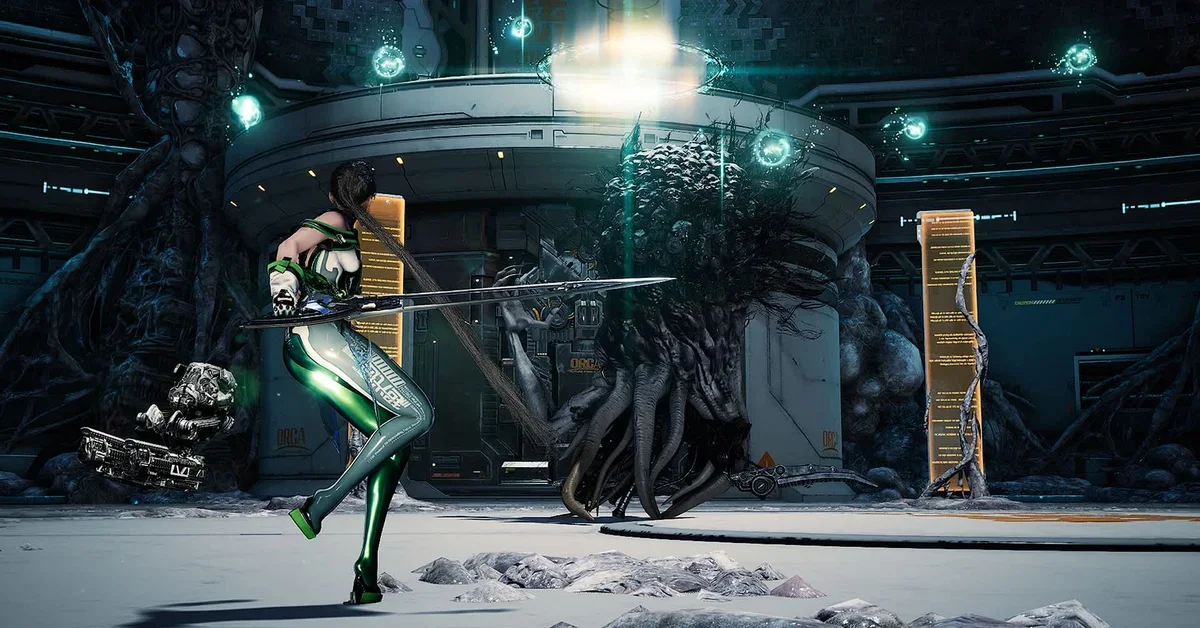
SHIFT UP targets 60 frames per second for Stellar Blade on Switch 2, in both handheld and docked mode, but it reaches that number with frame generation: the game renders a steady 30 fps base, upscales with Nvidia DLSS, and uses AMD’s FSR 3.1 frame interpolation to double the output. After the demo, SHIFT UP promised a toggle at release so you can turn frame generation off.
Updated November 5, 2026: the game is out. As of launch day, SHIFT UP has published no Switch 2 patch notes or settings details, so the toggle below is still the studio’s promise, and we removed impressions of the unfinished preview build.
Below we lay out what the studio has said on the record, how the technique works and what it costs, and what the frame generation toggle changes. Stellar Blade Complete Edition launched on Switch 2 on November 5, 2026, and everything here is checked against SHIFT UP’s own statements as of that day. Whether it ships on a real cartridge is covered in our game-key card guide.
SHIFT UP’s Official Targets
The most detailed explanation comes from SHIFT UP CTO and technical director DongKi Lee, in an interview with Nintendo Everything published on August 31, 2026:
- Target: “So we targeted 60 frames per second in both handheld mode and docked mode.”
- Upscaling: “We use DLSS for upscaling.” Lee noted that the Switch 2’s DLSS support has no frame generation feature of its own.
- Frame generation: the team took “AMD’s FSR 3.1 for PC and used the feature called frame interpolation.”
- The base rate: “We have 30 frames per second to have it even and then use interpolation.” Lee said “it was important to have even latency for players,” which is why the base is locked rather than left to float.
SHIFT UP CEO and director Kim Hyung-tae added his own numbers at Tokyo Game Show 2026. He told Inven Global that “the one thing I didn’t want to give up on until the end was 60fps,” that the team adjusted resolution and upscaling in both modes to deliver 60fps “in most situations,” and, candidly, that “there are instances where it drops to around 50fps.”
| Item | What SHIFT UP has said |
|---|---|
| Frame rate target | 60 fps, handheld and docked |
| Base render rate | 30 fps, then interpolated |
| Upscaling | Nvidia DLSS |
| Frame generation | AMD FSR 3.1 frame interpolation |
| Known dips | “around 50fps” in some instances, per Kim |
| Frame generation toggle | Promised for release |
How Frame Generation Works Here
Frame generation inserts an extra, estimated frame between each pair of real frames. Motion looks close to 60 fps, but the game still only reads your inputs and simulates the world at its 30 fps base, so the controls do not respond like a native 60 fps game. Interpolated frames can also show artifacts around fast-moving objects.
That matters in Stellar Blade more than in most games, because combat is built around parries and perfect dodges. AMD’s own guidance for FSR 3 frame generation recommends a base frame rate of 60 fps or higher before interpolation, so a 30 fps base is a demanding use of it. Lee’s answer was consistency: an even 30 fps base gives the same latency every frame, which is easier to learn than a rate that swings.
Capcom took a similar approach on the same hardware: our Dragon’s Dogma 2 Dark Arisen Switch 2 guide covers its optional frame generation setting.
The Frame Generation Toggle
The Switch 2 demo keeps frame generation on with no way to disable it. On September 23, SHIFT UP posted on X: “We’ve been watching your feedback closely and decided to add a Frame Generation toggle at release. We hope this lets you play the way that looks and feels best to you!”
As of launch day, SHIFT UP has not published Switch 2 patch notes, where the toggle sits in the settings, or what the game targets with frame generation switched off. Based on Lee’s description of a fixed 30 fps base, turning it off should leave you at that base rate with less latency and no interpolation artifacts, but treat that as our reading of his explanation until SHIFT UP confirms it.
Resolution and Visuals
SHIFT UP has not published resolution figures. Kim’s comment that the team got to 60fps “by adjusting resolution and upscaling for both docked and handheld modes” confirms the trade-off without giving numbers.
Nintendo’s store listing confirms TV, tabletop and handheld play, touch screen support, and HDR output on compatible TVs.
What Is Still Unconfirmed
- Exact internal and output resolution in each mode
- The frame rate target with frame generation off
- Where the frame generation toggle sits in the settings, and whether it is on the cartridge or in a patch
- How much the final build improves on the demo
The free Switch 2 demo on the eShop is still the best way to judge the trade-off before you buy, keeping in mind that it lacks the toggle.
Frequently Asked Questions
Does Stellar Blade run at 60 fps on Switch 2? SHIFT UP targets 60 fps in both modes using frame generation from a 30 fps base. Kim Hyung-tae said it holds 60 in most situations and can drop to around 50 in some.
Can you turn off frame generation in Stellar Blade on Switch 2? SHIFT UP said on September 23 it would add a frame generation toggle to the full game at release. As of launch day, it has not published patch notes or menu details for it, and the demo does not have it.
What resolution does Stellar Blade run at on Switch 2? SHIFT UP has not said. Kim Hyung-tae said only that the team adjusted resolution and upscaling in both modes to reach 60 fps.
Does Stellar Blade use DLSS on Switch 2? Yes. Lee said DLSS handles upscaling, while frame generation comes from AMD’s FSR 3.1.
Is there a performance mode? SHIFT UP has not announced separate quality and performance modes. The only graphics option it has announced for Switch 2 is the frame generation toggle.
Is Stellar Blade on Switch 2 worse than PS5? It is a lower-fidelity version, by SHIFT UP’s own account of the resolution and upscaling trade-offs. The content is the same Complete Edition.
For how other big ports handled the hardware, see our Witcher 3 Remastered Switch 2 guide, and for the strongest games on the system, our best Switch 2 games of 2026.