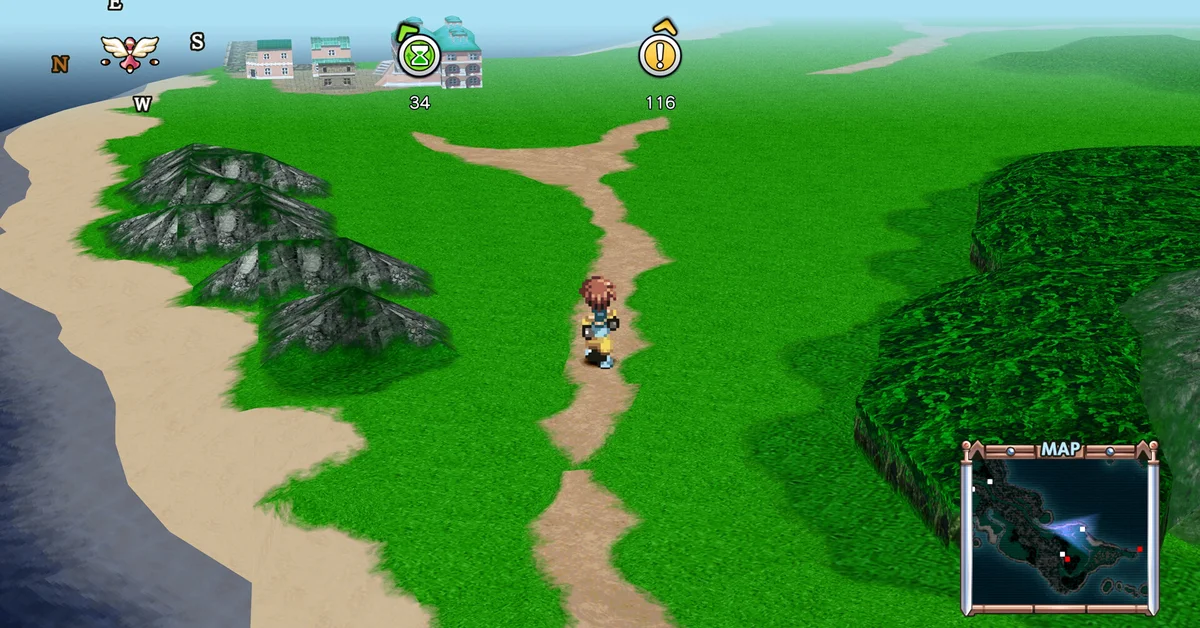
Expect roughly 25 to 45 hours for the main story of Tales of Eternia Remastered and 50 to 60 hours or more if you chase most of the side content, going by reviews of the original PlayStation and PSP releases the remaster is built on. Bandai Namco has not published an official playtime, and the remaster’s new Boost function, encounter toggle and fast auto-battle can pull a story run below the original’s numbers if you use them.
Below is where those estimates come from, what makes this version faster or slower than the original, and what changes on a second playthrough.
No Official Number Yet
Bandai Namco’s announcements in the US, Europe and Japan describe the remaster’s features but give no hour count. What the Japanese official site does make clear is the starting point: the remaster is developed from the 2005 PSP version of Tales of Eternia, with some specifications changed. The story, dungeons and side quests are that game’s, so the original’s length is the best guide we have.
The PlayStation original reached North America in 2001 under the name Tales of Destiny II, which is why older playtime figures often appear under that title.
How Long the Original Took
Reviews from the time, collected in RPGamer’s archive for the PlayStation and PSP releases, put a first playthrough anywhere from 20 to 60 hours. Most landed in the 30 to 45 hour range for the story, with side quests pushing the total toward 50 or 60. One PSP reviewer estimated 25 to 30 hours for a player who rushes, reported about 35 hours with a few optional areas, and suggested 40 to 45 hours to find all the secrets.
| Play style | Estimate from the original’s reviews |
|---|---|
| Story only, minimal detours | About 25 to 30 hours |
| Story plus a reasonable amount of side content | About 30 to 45 hours |
| Most side quests, secrets and optional bosses | About 45 to 60+ hours |
Treat these as ranges, not promises. They come from individual reviewers on the original hardware, before any of the remaster’s speed-up options existed.
What Makes the Remaster Faster
Bandai Namco’s feature list is mostly about cutting friction, and several options directly shorten a run:
- Boost function. Bandai Namco America describes it as adjusting experience gained and encounter frequency. Per the Japanese site, most Boost settings can be changed at any time from Menu > Custom.
- Turn random encounters off. You can disable enemy encounters to explore and follow the plot in peace, then switch them back on to level up.
- High-speed auto-battle. In AUTO battle mode, a button press switches combat to high speed; press it again to return to normal.
- High-speed field movement. Hold a button to move faster on the field, or set fast movement as your default.
- Destination icons. A yellow “!” marks main story destinations, with the distance shown, so less time is spent wondering where to go.
- Skips. Hold a button to skip events, skits and movies, and mini-games can now be skipped or retried.
- Battle Retry and Quick Recovery. A normal-battle game over offers a retry, and Quick Recovery heals the whole party’s HP and status ailments from the menu.
One note if you turn encounters off: fewer battles means less experience, so pair it with Boost or plan some grinding before major bosses. Bandai Namco has not said how much time any of these options saves.
What Makes It Longer
Completionists have more to do than in the original, mostly because content now arrives earlier:
- Nereid’s Labyrinth on the first run. This high-difficulty optional dungeon was only available on a second playthrough in the original. In the remaster, the Japanese site says it unlocks late in the first playthrough.
- Timed events are flagged. An hourglass icon marks events tied to titles and items you can only get during a limited window, and a star icon marks valuable items such as books and maps. Clearing every one adds hours but saves a second run for missed items.
- The arena’s top bracket is repeatable. The Inferia Arena’s champions’ tournament can be replayed after you win it, though its reward items come once per playthrough.
- Tougher difficulty from the start. Extreme difficulty is open from the beginning; the Japanese site notes the original only unlocked its hardest setting on a second playthrough. Harder fights take longer.
- Collections. Recipes, Lenses, the Collector’s Book and the Monster Book all carry the completion time well past the story.
New Game Plus and Second Playthroughs
Loading a clear save opens a carry-over screen where you switch each element on or off, including character data, learned artes, items, cooking recipes, Lens progress, the Collector’s Book and the Monster Book. The Japanese site marks title carry-over as part of the version 2.0.0 update.
A second playthrough also unlocks:
- Unknown difficulty, a new setting added for the remaster.
- Every skit in the Skit Player, not just the ones you have seen.
- Battle Voice, Scenario Voice and Movie Select in the Sound Player.
With your levels and artes carried over and every skip option available, a second run should take far less time than the first. The remaster also has 20 manual save slots plus an autosave, per the Japanese spec table, so you can keep a clear save for each difficulty.
If you are still deciding which version to buy, our guide to Tales of Eternia Remastered’s physical release covers the boxed editions and the Switch versus Switch 2 question. For length comparisons with another long-running RPG series, see how long each Kingdom Hearts game takes, and our upcoming releases calendar covers what launches next.
Frequently Asked Questions
How long is the Tales of Eternia Remastered main story?
About 25 to 45 hours, based on reviews of the original releases the remaster is built on. Bandai Namco has not given an official figure.
How long does it take to 100 percent?
Around 50 to 60 hours or more, judging by the original. Earlier access to Nereid’s Labyrinth and the repeatable arena add to that.
Is the remaster shorter than the original?
It can be. The story is the same, but the Boost function, encounter toggle, fast auto-battle and skip options can cut a run down if you use them.
Is there New Game Plus?
Yes. Loading a clear save lets you choose what carries over, and the second playthrough unlocks Unknown difficulty.
Can you skip cutscenes?
Yes. Holding the skip button skips events, skits and movies.
Which version of Tales of Eternia is the remaster based on?
The 2005 PSP version, according to the Japanese official site.