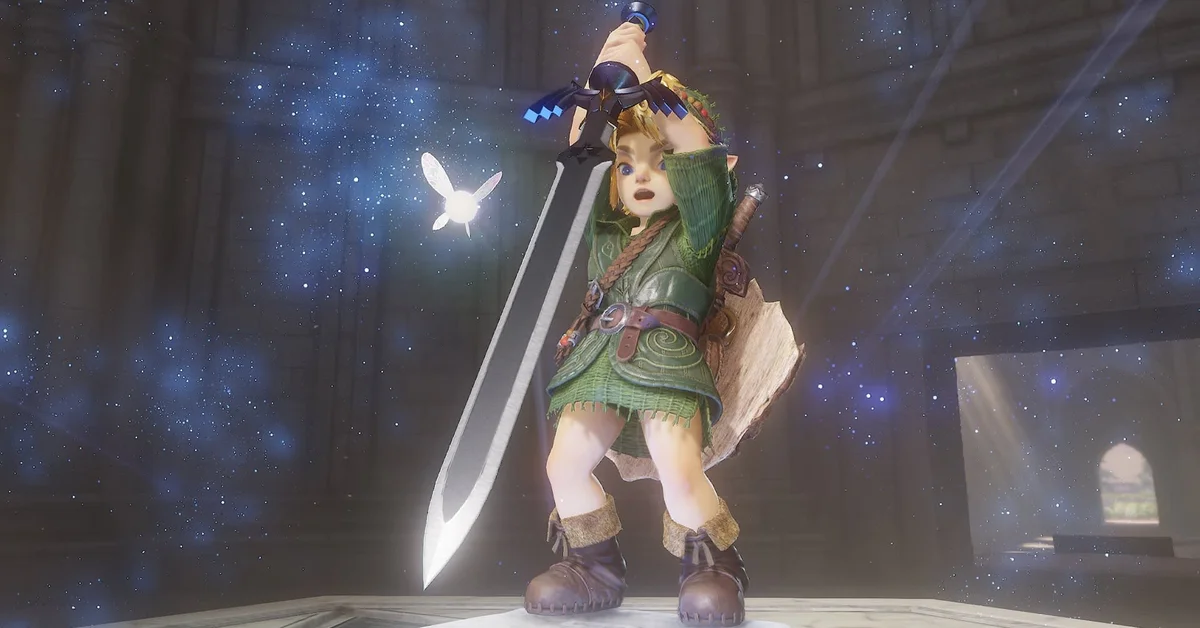
No. The Ocarina of Time remake on Switch 2 has no Hero Mode and no difficulty setting of any kind: it launched on November 5 with one way to play, and Nintendo has not announced a harder mode since. Master Quest, the remixed second quest from the 3DS version, is not in the game either.
That surprises a lot of people, because most of Nintendo’s recent Zelda remakes have one. Below is what the remake does ship with, what its Options menu holds, what the developers said about difficulty, and how to make a run tougher on your own.
What Nintendo Shipped
The Legend of Zelda: Ocarina of Time came out on November 5, 2026, and Nintendo’s launch post runs through everything the remake adds: rebuilt visuals, fully voiced cutscenes, the Hall of Fallen Foes, fairy thoughts hidden around Hyrule, playing the ocarina into the console’s microphone, ZELDA NOTES support and Nintendo Today cards. None of those is a difficulty option. The store page lists no Hero Mode, no Master Quest and no difficulty select either.
The additions are about breadth and comfort rather than challenge. Our list of everything that changed in the remake covers each one, and our guide to whether Master Quest is included covers the other mode people go looking for.
What the Options Menu Holds
If the remake had a difficulty setting, the Options menu is where you would expect to find it. Press +, go to the System tab and open Options, and the list is all camera, control and presentation settings:
- amiibo and ZELDA NOTES
- Invert Vertical Camera, Invert Horizontal Camera and Camera-Rotation Speed
- Motion-Control Aiming and Targeting Type
- Swap Jump Controls
- Ocarina Mic Input and Swap Ocarina-Playing Controls
- In-Game Interface, Subtitle Display and Subtitle Speaker-Name Display
- Voice Language and Controller Vibration


The screenshots in this guide come from two of our other Ocarina of Time remake recordings on Switch 2.
Nothing on that list changes how much damage Link takes or how tough enemies are. Our camera settings guide, motion aiming guide and microphone ocarina guide cover the settings that are there.
Why People Expected a Hero Mode
Nintendo has given most of its modern Zelda remakes a Hero Mode, which doubles the damage Link takes and stops recovery hearts from dropping. The Wind Waker HD and Twilight Princess HD both let you start a file in it, the 2019 Link’s Awakening on Switch offers it from the first file, and Skyward Sword HD unlocks it after the credits.
Ocarina of Time itself took a different route. Ocarina of Time 3D in 2011 had Master Quest instead: a remixed set of dungeons in a mirrored Hyrule, with enemies that hit twice as hard. So whichever way people looked at it, a harder way to play seemed likely for the Switch 2 version. It did not happen.
What the Developers Said About Difficulty
Nintendo’s own Ask the Developer interview points the other way, toward a game that is easier to follow rather than harder to beat. Hidemaro Fujibayashi says in part 4:
“Games from the Nintendo 64 era were comparatively quite difficult, and players often relied on strategy guides. For this game, though, we wanted players to be able to work out what to do next within the game itself.”
Series producer Eiji Aonuma says in part 3 that the Water Temple was adjusted for the same reason: “Since it became well known for its difficulty in the original game, I had the team make some adjustments in this version.” Our guide to what changed in the Water Temple covers those adjustments.
Add Threads of Time, the new quest log and objective tracker, and the direction is clear: the remake smooths out the confusion of 1998 and leaves combat as it was.
How to Make the Remake Harder Yourself
There is no switch to flip, but you can still build a tougher run:
- Race the clock in the Hall of Fallen Foes. Every boss you beat gets a statue with a Rematch option, and the rematch runs a timer that the statue records. It is the closest thing the remake has to a challenge mode. Our Hall of Fallen Foes guide explains how it works.
- Leave the Heart Pieces alone. All 36 are optional, so skipping them keeps Link close to his starting hearts plus what the bosses give him. Our Heart Piece guide shows what you would be passing up.
- Skip the defensive upgrades. Double Defense and Nayru’s Love both come from Great Fairies you never have to visit, as our Great Fairy Fountain guide shows.
- Carry no fairies or potions. Empty bottles are the remake’s safety net. Go without them and every boss fight counts.
Could Nintendo Add One Later?
Nintendo has not announced a Hero Mode, Master Quest or any other difficulty option for a future update, and there is no DLC or expansion for the remake. Our price and editions guide covers what each version includes. If you are deciding whether the game is worth it as it stands, our review covers how it plays, and every remake guide is on our Zelda hub.
Frequently Asked Questions
Does the Ocarina of Time remake have Hero Mode? No. The remake launched without a Hero Mode, and Nintendo has not announced one.
Is there a difficulty setting in the Ocarina of Time remake? No. The Options menu covers the camera, controls, ocarina input, subtitles, voice language and vibration, with nothing that changes difficulty.
Is Master Quest in the remake? No. It was part of Ocarina of Time 3D, but it is not in the Switch 2 remake and has not been announced for it.
Does a harder mode unlock after beating the game? Nintendo lists no mode that unlocks after the credits, Hero Mode included.
Is the remake easier than the original? The developers set out to make it easier to follow. Fujibayashi says they wanted players to be able to work out what to do next within the game itself, and Aonuma says the Water Temple was adjusted because of its reputation for difficulty.