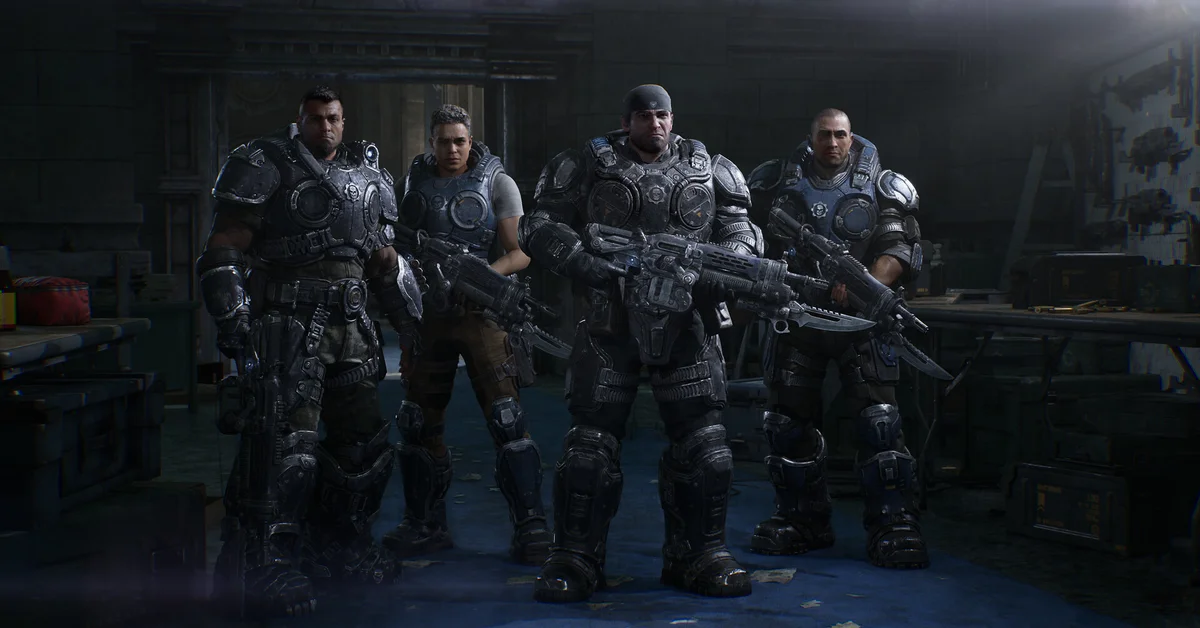
Gears of War: E-Day has two multiplayer pillars: Horde Siege, a 12-player PvE mode where three squads of four fight the Locust on the same city map, and Versus, 4v4 PvP with four core modes on six launch maps. Classic wave-survival Horde still exists too, as a playlist inside Horde Siege.
Below we cover Horde Siege missions, classes and difficulty, every Versus mode and map, progression and online access. Everything is verified against The Coalition’s official multiplayer deep dive and Xbox Wire, and reflects launch content for Gears of War: E-Day on Xbox Series X|S and PC. Early access opened on October 1 for Premium Edition owners, and the full launch followed on October 6.
How Horde Siege Works
Each squad deploys with its own mission, joins a battle already in progress, crosses paths with the other squads and finishes with a final fight and extraction by Raven. Only one squad member has to board the chopper for the mission to count.
- Maps. Three at launch, each built across several city blocks of Kalona. The beta map was Golden Quarter, set in the city’s historic district.
- Energy. Kills and objectives fill a shared squad pool, but each player spends individually at Supply Caches on equipment, grenades, weapons and Squad Perks (in-session buffs). Energy also buys and upgrades turrets, which can be ripped off their mounts as heavy weapons.
- Death. A killed player drops their COG tags. Squadmates carry them to a Supply Cache to revive you, and a player from another squad can pick them up to revive you instantly. If your whole squad dies you lose a Squad Life, and running out fails the mission with partial XP.
- Invasion Events. Boss-scale Locust such as a Corpser or a Brumak arrive for everyone, with a map-wide modifier that can block extraction or disable Supply Caches. Every squad that helps shares the rewards.
- Poisons. Each main-objective boss wave you clear makes your squad’s Locust tougher, so whether to detour for side objectives first becomes a real squad decision.
Secondary objectives earn Weapon Parts, free gear and Squad Perks, but you only keep Weapon Parts if someone in your squad extracts.
What Changed for Horde Siege at Launch
The Coalition’s launch notes list a round of Horde Siege tuning since the August beta. The changes that matter most to new squads:
- Fewer Weapon Parts from taking part in Invasions and from Weapon Part Stockpiles.
- Harder Invasions, and harder Commander and Allfather difficulties.
- Higher costs: equipment costs more, Squad Perks cost more Energy, and some Squad Perks do less.
- Medic changes: the Medic’s stim duration was adjusted.
- Execution threshold lowered: Boomers, Flayers and Grinders now have to be at lower health before a Prototype Lancer can execute them.
- Repair objectives had their difficulty adjusted.
In short, the beta’s farming routes pay less, so extraction matters even more. Our weapon mods guide explains how Weapon Parts work.
Horde Siege Fixes in the October 14 Patch
The Coalition’s October 14 patch notes fix 15 Horde Siege bugs. The ones squads are most likely to have hit:
- Invasion Events: the Corpser could become unkillable during an Invasion Event, and the Scoria Invasion Event had multiple issues.
- E-Holes: enemies emerging from E-Holes were briefly invisible, and E-Holes could interfere with Secondary Objective locations.
- Extraction: missions would not end if squad members left the match during extraction.
- Medic: the Stim Vaporizer did not revive friendly players when the Friendly Fire modifier was active.
- Objectives: two squads could have the same R.I.G. objective at once, and players could not interact with a damaged R.I.G. during the defense phase of Repair objectives.
- Spawns and spectating: players could spawn in with missing ammo, and could not change the spectator camera after dying.
The same patch fixed multiple Weapon Mods that did not perform as described, in Horde Siege and the Campaign.
Playlists, Objectives and Difficulty
| Playlist | What it is | Length per The Coalition |
|---|---|---|
| Blitz | 1 or 2 objectives | About 15 to 20 minutes |
| Siege | Multiple objectives across the map | 20 to 40 minutes |
| Horde | Hold one spot through 10 waves | Up to 50 to 60 minutes |
Missions revolve around R.I.G.s (Resonation Imaging Geographers), COG scanners mapping the Locust tunnels. Five objective types ship at launch: Secure, Calibrate, Repair, Defend and Horde.
Difficulty scales with class level. The deep dive names three upper tiers: Infantry (recommended for class levels 10 to 20), Commander (20 to 30) and Allfather (max-level classes only). Harder tiers pay better rewards.
The Four Horde Siege Classes
Each class has its own loadout, combat bonus and cooldown-based Tactical Gear:
- Assault: mid-range flexibility, a Sonic Disruptor that stuns incoming waves, and bonus damage in cover.
- Breacher: close-range pusher with an Adrenaline Injector that refills health and cuts damage taken, plus resistance to status effects and melee.
- Marksman: precision damage, a Pulse Drone that tags Locust for the squad, and stronger critical hits.
- Medic: revive specialist whose Stim Vaporizer heals and revives any Gear in range, even downed players from other squads, plus faster health regen.
Each class has 30 levels at launch, unlocking loadout weapons, Armor Mods, Tactical Gear Mods and Weapon Mods. Weapon Mods, a first for a mainline Gears game, cost Weapon Parts and are shared across classes, and one lets you fit a bayonet to the Gnasher. Any skin works with any class, and more classes arrive with seasonal updates. Our Horde Siege class guide ranks them.
Versus Modes and Maps
Every Versus mode is 4v4 with identical starting loadouts and no weapon mods. Teams fight over on-map Power Weapons instead. The four launch modes:
- Team Deathmatch: burn through the enemy team’s lives, now with dynamic respawns that follow the fight.
- Conquest: a King of the Hill variant where a zone stays active until one team banks enough time in it to score.
- Demolition: carry a neutral bomb to one of two enemy sites. Once it is armed, the planting team defends it without respawns; three detonations wins.
- Crucible: new for E-Day. Hold the carryable Power Core inside a zone that moves and shrinks, and use its electrical charge to fend off attackers.
The six launch maps are Outpost, Battleship, Park, Precinct, Market and Skyward. Playlists split into Ranked, with per-mode ranks and quit penalties, and Social, which covers Quickplay, Player vs Bot and limited-time modes. Ranked did not open on day one: Versus Ranked launched on October 13, a week after the full launch, so players had time to learn the maps and modes first. A placement bug put some players in the wrong skill division on that first day, and The Coalition fixed it in the October 14 patch; our Ranked guide explains placements and Rank Rating. The same patch fixed a batch of Versus bugs, including a Demolition bomb that could become un-interactable if dropped while planting, Conquest zones on Precinct that could be controlled from outside the zone, and spawn protection that did not end when hip firing. The Halloween event opened on October 22 with a limited-time Trick-or-Treat mode in Versus, where players in pumpkin heads battle for the Jack-o-Cannon and both teams hunt for special weapons (and tricks) hidden in pumpkins around the map, and an event mission against the Boogeyman in Horde Siege, per The Coalition’s October 22 hotfix notes. Our Halloween event story has the details. The 20 Years of Gears event followed on November 3, bringing back Guardian in Versus, where only one leader makes it out alive, and adding For the Queen to Horde Siege, a mode with the Supply Cache disabled, so squads rely on their loadouts. The Coalition’s November 6 patch then toned down three weapons: the Striga, the Lancer Mk1 and the Gut-Puncher.
Also missing at launch, per The Coalition: Private Lobbies, leaderboards, Meat Shields and Chainsaw Duels. The studio says these are “not gone from the franchise” and is weighing them for post-launch updates or its next game.
On aim assist: The Coalition’s August beta notes said aim assist “only affects Campaign and Horde Siege,” but its official X account later clarified on August 12 that it had “oversimplified.” The Default setting gives a standard level of controller assist in every mode, Versus included, as in past Gears games, and you can turn it off entirely. The Coalition’s support guide describes two stronger levels, Snap Aim and Lock-on Aiming, and reports of the full clarification say those two are the ones limited to Campaign and Horde Siege. Our controller settings guide explains every level. The new movement also changes the classic cover-cancel game, which our wall bounce guide covers, and our Gnasher guide covers the shotgun fights that decide most rounds.
Progression and What You Need to Play Online
There is no battle pass, and nearly every cosmetic is earnable by playing: matches, medals and level milestones pay Coins to spend in the Barracks, while paid Iron is optional. Player Level caps at 100, and you can Re-Up four times for a set of Gears 2 style wings. Each week brings 12 challenges, split evenly between Horde Siege and Versus. Premium Edition owners got the first week’s challenges on October 1; per The Coalition, they were the same ones every player received on October 6, and the second set followed on October 13.
The Coalition has committed to five post-launch seasons. Season 1: Emergence started with early access and runs eight weeks, until December 1, with three two-week events (Halloween, 20 Years of Gears and Thanksgibbing). Season 2, called Legacy, starts December 1 and keeps celebrating the series’ 20 years, and for the anniversary itself every player can claim RAAM as a free multiplayer character by logging in from November 7. The Shop rotates every Tuesday.
Boot Camp teaches the new controls, and Combat Training offers a practice map for up to four players.
Online access:
- On Xbox, The Coalition’s beta FAQ says multiplayer requires Game Pass Essential or higher. Our PS5 and Game Pass guide breaks down every plan.
- Play is cross-platform across Xbox and PC. On Steam, sending a cross-platform squad invite requires linking an Xbox account, per the same FAQ. Our Steam and PC guide has the details.
- Horde Siege supports proximity voice chat with nearby squads, which you can toggle in the audio settings. Our ping guide covers marking enemies for your squad.
- If you cannot connect, our error codes guide lists the official fixes.
Campaign co-op is separate from both modes, and our co-op guide covers it. For the launch timeline, see our gone gold story, and find every guide on our Gears of War: E-Day hub.
Frequently Asked Questions
Does Gears of War: E-Day have Horde mode? Yes. Horde returns as a playlist inside Horde Siege, where your squad defends one R.I.G. through 10 waves.
How many players are in Horde Siege? Twelve: three squads of four, each running its own mission on the same map.
What Versus modes are in Gears of War: E-Day? Team Deathmatch, Conquest, Demolition and the new Crucible at launch, all 4v4, plus rotating limited-time modes.
When did Ranked open in Gears of War: E-Day? Versus Ranked opened on October 13, one week after the October 6 full launch. The Coalition’s October 14 patch fixed a placement bug that put some players in the wrong skill division on the first day.
Does aim assist work in Versus? Yes. The Coalition clarified that the Default aim assist setting applies standard controller assist in every mode, including Versus. You can also turn it off.
Is there a battle pass in Gears of War: E-Day? No. The Coalition says nearly every item can be earned by playing, with Coins as the free currency and Iron as an optional paid one.
How many Horde Siege maps are there? Three at launch, each set in a different district of Kalona, with more promised after launch.